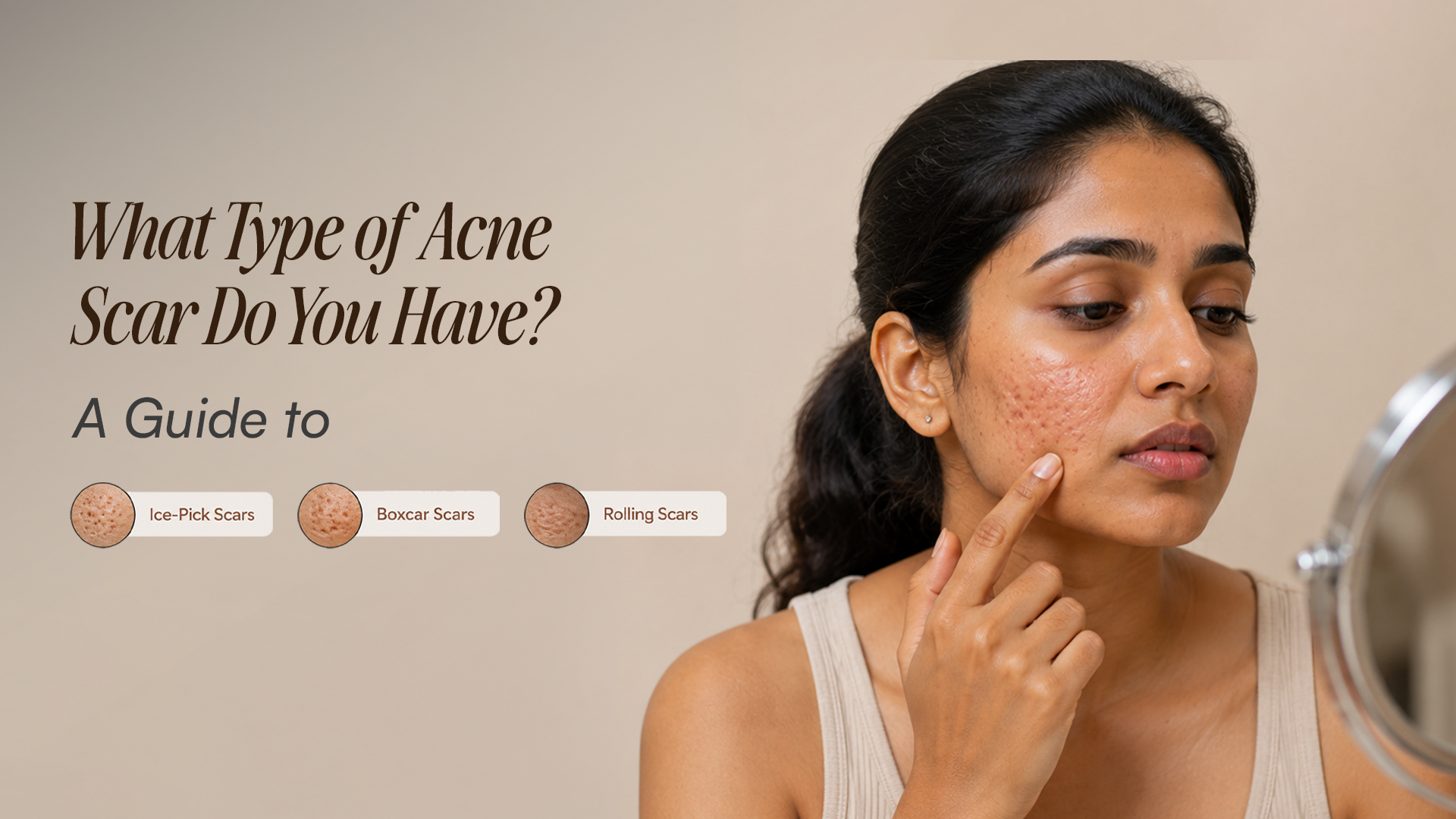
If you've ever typed "how can I get rid of pimple scars" into Google at 1am, you already know the frustrating part is most of the advice you find treats all scars like they're the same problem. They're not. A scar that looks like a tiny pinprick and a scar that looks like a shallow dent are not going to respond to the same cream, the same peel, or even the same laser. Before anything actually works, you need to know exactly what you're dealing with.
Dermatologists classify acne scarring into three main types: ice-pick, boxcar, and rolling and each one forms differently beneath the skin, which is exactly why treating them all the same way so often disappoints.
Why Pimple Scars Aren't All the Same Underneath
When a breakout heals, your skin is supposed to rebuild the collagen and tissue that inflammation damaged. Sometimes that rebuilding process falls short, and the result is a scar. But how it falls short whether tissue is lost, pulled, or unevenly rebuilt determines what the scar actually looks like and, more importantly, what it takes to treat it. That's the whole reason scar classification exists in the first place.
Ice-Pick Scars
Ice-pick scars are small, deep, and narrow, think of a tiny puncture mark, often no wider than a pore, but extending surprisingly deep into the skin. They usually show up across the cheeks and can be felt as a distinct little indentation if you run a finger over them.
Because they go so deep relative to how small they look on the surface, ice-pick scars tend to be the most stubborn of the three. Surface treatments like light peels barely make a dent they genuinely need something that can work at depth.
Boxcar Scars
Boxcar scars are wider than ice-pick scars, with sharply defined edges and a flat, box-like base similar in appearance to chickenpox scarring. They can vary from shallow to fairly deep, but the defining feature is always that crisp, cliff-like edge rather than a gradual slope.
You'll typically spot these along the jawline and lower cheeks. What makes them visually noticeable, even once healed, is that sharp border the surrounding skin doesn't blend into the scar the way it does with other types.
Rolling Scars
Rolling scars are the trickiest to spot by description alone, because they don't have a clear edge at all. Instead, they create a soft, wave-like unevenness across the skin caused by fibrous bands of tissue beneath the surface pulling the skin down from underneath.
They're broad, shallow-looking, and tend to become more obvious under certain lighting or when the skin is stretched. Since the actual damage is happening underneath, in the connective tissue, surface-only treatments usually can't resolve rolling scars on their own.
A Quick Way to Compare All Three
| Scar Type | Shape | Depth | Edges |
|---|---|---|---|
| Ice-Pick | Narrow, pinpoint | Deep | Sharp, punctured |
| Boxcar | Round or oval | Shallow to deep | Sharp, well-defined |
| Rolling | Broad, wave-like | Shallow to moderate | Soft, undefined |
Here's the honest bit most people don't have just one type. A mix of all three is actually pretty common, which is exactly why guessing your way through a treatment plan rarely gets great results.
So How Do You Actually Know Which One You Have?
This is where a proper skin assessment matters far more than a mirror and good lighting. At VCare's Centre of Excellence, every scar evaluation starts with AI Skin Analysis, which maps depth, texture, and scar pattern with a level of precision that's genuinely hard to judge by eye alone. It's the difference between guessing and actually knowing what you're treating.
What Treatment Actually Looks Like
Once VCare has a clear picture of your scar type and depth, the treatment approach follows from there rather than being decided in advance. For deeper, more resistant scars particularly ice-pick and deep boxcar types the go-to technology is the Erbium YAG Laser Treatment, an ablative resurfacing laser that works layer by layer to rebuild collagen from within rather than just smoothing the surface.
Rolling scars, since the real issue sits beneath the skin, often respond better to approaches that address those fibrous bands directly, sometimes paired with regenerative support to speed up healing. PDRN Injection Treatment is commonly layered into scar-correction plans at VCare for exactly this reason it accelerates the skin's natural repair process alongside laser treatment rather than replacing it.
Because most people are actually dealing with a mix of scar types, VCare's approach usually layers more than one technology together rather than relying on a single tool to fix everything. If you want a deeper technical breakdown of the specific lasers used for scar correction, VCare has a full guide covering Laser Treatment for Acne Scars that walks through the options in more detail.
What If You're Still Getting Breakouts?
It's worth mentioning if you're still dealing with active acne while also managing old scarring, treating the scars alone won't get you very far, since new breakouts can just create new scars behind them. In that case, it's worth addressing both at once rather than treating scarring in isolation. VCare's Acne Treatment page covers what an active-acne management plan looks like alongside scar correction.
Figuring out how to get rid of pimple scars isn't really about finding the "best" product or treatment in general, it's about matching the right approach to the specific type of scarring you actually have. That distinction alone is often what separates a treatment plan that works from one that doesn't.
Book an Appointment | Discover Vcare's Centre of Excellence Difference
Frequently Asked Questions
Can I have more than one type of acne scar at the same time?
Yes, this is actually the norm rather than the exception. Most people dealing with long-term scarring have a mix of ice-pick, boxcar, and rolling scars rather than just one, which is why a personalized assessment matters more than guessing.
Which type of acne scar is hardest to treat?
Ice-pick scars are generally considered the most stubborn, since their depth and narrow shape make them harder to reach with anything other than deeper resurfacing technology.
Do all types of pimple scars need laser treatment?
Not necessarily. Depth and type both play a role; some rolling scars respond well to regenerative therapies, while deeper ice-pick and boxcar scars typically need resurfacing lasers like Erbium YAG.
How can I tell what type of scar I have without a professional opinion?
A basic visual and touch check gives some clues: a sharp, narrow puncture usually points to an ice-pick scar, clean round edges point to boxcar, and a soft, wavy texture points to rolling. That said, a proper skin assessment is really the only reliable way to confirm both type and depth before starting treatment.
Does treating pimple scars also help with pigmentation left behind by acne?
Often, yes. Post-inflammatory pigmentation frequently overlaps with textural scarring, and treatment plans at VCare typically account for both rather than addressing texture alone.